A residential electrical inspection typically covers your main service panel, branch circuit wiring, outlets, switches, grounding systems, GFCI and AFCI protection, and visible electrical components throughout the home. Most inspections take 1 to 3 hours depending on the size of the house and its age.
If you own a home in Fort Collins, Loveland, Boulder, Denver, Erie, or anywhere across Northern Colorado, understanding what an inspection includes helps you prepare, ask the right questions, and avoid costly surprises down the road.
This guide breaks down every major area a residential electrical inspection covers, what inspectors look for, and what issues are most common in homes across our region.
Understand What a Residential Electrical Inspection Actually Is
A residential electrical inspection is a structured review of your home’s electrical system performed by a licensed electrician or certified home inspector. It is not a code compliance audit in the strictest sense, but it does evaluate safety and functionality against current standards.
There are two main types of residential electrical inspections:
- Pre-purchase inspection: Ordered by a buyer before closing to identify existing problems.
- Safety inspection: Ordered by a homeowner to verify the system is operating safely, often before a renovation or after buying an older home.
Permit-based inspections happen after electrical work is completed and are conducted by a municipal inspector. These are separate from the inspections a licensed electrician like Docheff Electrical performs for homeowners on request.
Knowing which type of inspection you need is the first step toward protecting your home and your family.
Inspect the Main Electrical Panel and Service Entry
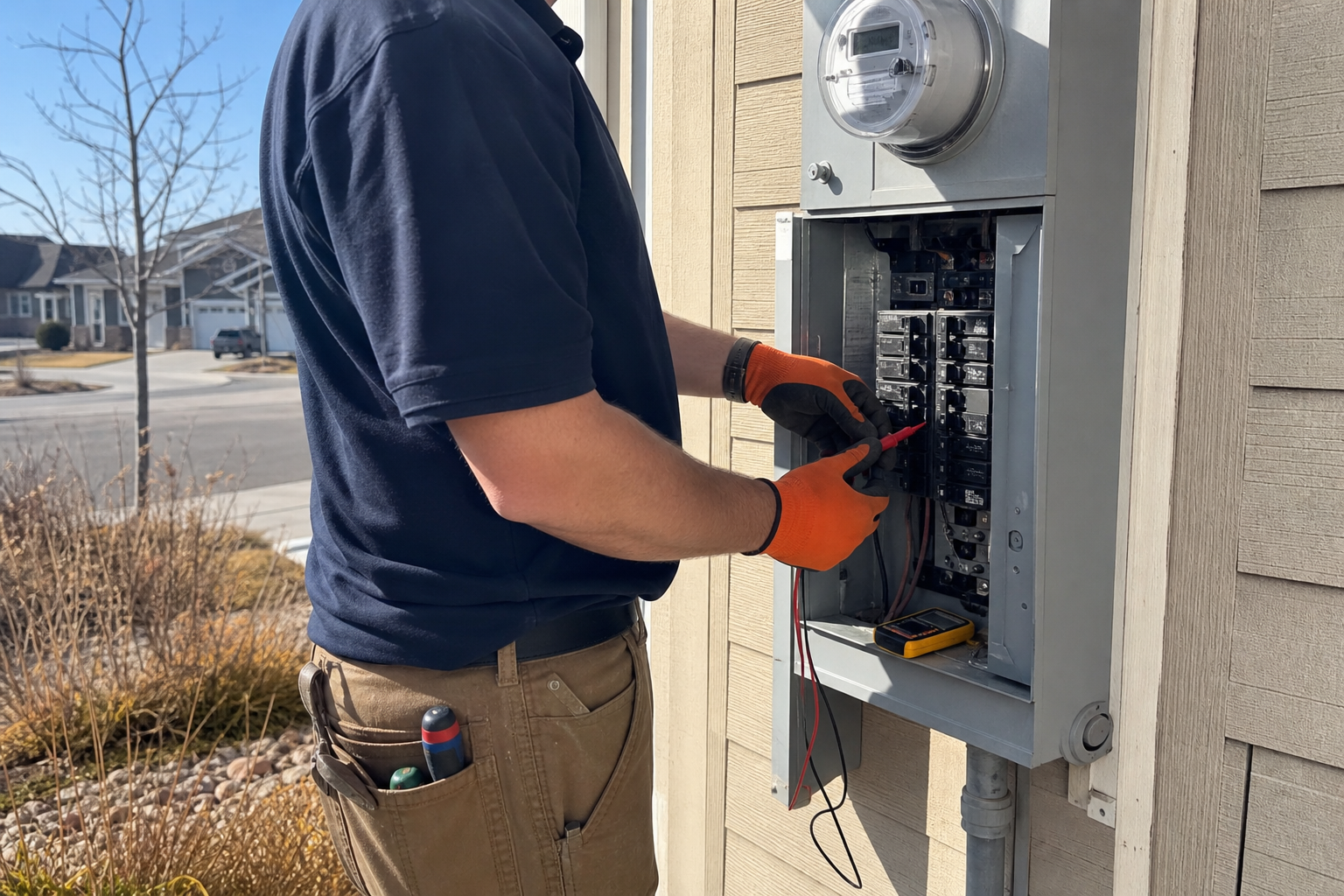
The main service panel is the starting point of every residential electrical inspection. This is the metal box where power enters your home and splits into individual circuits. Inspectors look at several things here.
| Panel Component | What the Inspector Checks | Common Issues Found |
|---|---|---|
| Main breaker | Rating matches service size, operates correctly | Undersized for modern loads |
| Circuit breakers | Proper sizing, no double-tapped wires | Double-tapping, wrong amperage |
| Panel brand and age | No recalled panels (Federal Pacific, Zinsco) | Recalled panels still in service |
| Wiring condition | No exposed, burned, or corroded wires | Heat damage, corrosion |
| Grounding and bonding | Proper grounding electrode system present | Missing or improper ground |
| Panel labeling | All circuits clearly identified | Unlabeled or mislabeled breakers |
Homes in older neighborhoods in Greeley, Lafayette, and Louisville often have panels that are 40 to 60 years old. Panels from that era may be undersized for today’s electrical loads or contain recalled breakers that no longer trip reliably.
Docheff Electrical frequently identifies Federal Pacific Stab-Lok panels during inspections in older Colorado homes. These panels have a documented history of failure and are a serious safety concern.
Review Branch Circuit Wiring Throughout the Home
After the panel, inspectors examine the wiring that runs through your walls, attic, crawlspace, and basement. This is where many hidden problems show up, especially in homes built before 1980.
Inspectors look for the following wiring concerns:
- Aluminum wiring: Common in homes built between 1965 and 1973. Aluminum expands and contracts more than copper, which can loosen connections and create fire risks.
- Knob-and-tube wiring: Found in homes built before 1950. This system lacks a ground wire and is not compatible with modern grounded outlets.
- Improper splices: Wire connections made outside of junction boxes, often found in attics and crawlspaces.
- Damaged insulation: Wiring with cracked, melted, or rodent-chewed insulation.
- Overloaded circuits: Too many devices on a single circuit, which causes repeated tripping or overheating.
In areas like Nederland, Lyons, and Estes Park, older mountain homes often still have knob-and-tube or aluminum wiring. These systems need careful evaluation before any renovation work begins.
Check Outlets, Switches, and Electrical Fixtures
Every accessible outlet, switch, and light fixture in the home gets examined during an inspection. This part of the process covers a lot of ground and surfaces many DIY wiring mistakes.
| Item Inspected | What Is Checked | Why It Matters |
|---|---|---|
| Standard outlets | Polarity, grounding, secure mounting | Reversed polarity can damage appliances |
| GFCI outlets | Present in wet areas, functioning correctly | Prevents electrocution near water |
| AFCI breakers | Present on bedroom and living area circuits | Prevents arc faults that cause house fires |
| Three-prong outlets | Actually grounded, not just three-prong | Ungrounded three-prong outlets offer false safety |
| Light fixtures | Secure, correct bulb wattage, no exposed wiring | Overlamping causes insulation fires |
| Switches | Proper operation, no sparking or heat | Faulty switches can arc and ignite |
GFCI outlets are required by code in kitchens, bathrooms, garages, basements, and outdoor areas. Many homes in Berthoud, Keenesburg, and Platteville that have not been updated since the 1990s are missing GFCI protection in several of these locations.
An inspector will test each GFCI outlet using a plug-in tester to confirm it trips and resets properly. Non-functioning GFCI outlets are a very common finding.
Evaluate Grounding, Bonding, and Surge Protection
Grounding is one of the most important safety features in any electrical system. It provides a path for fault current to safely return to the earth rather than passing through a person or igniting a fire.
During an inspection, the grounding system review includes:
- Confirming a grounding electrode is installed (ground rod or water pipe connection).
- Checking that the grounding electrode conductor is properly sized and connected.
- Verifying that metal water pipes and gas piping are bonded to the electrical system.
- Testing outlets with a plug-in tester to confirm grounding is present at each receptacle.
- Checking for any open grounds, which occur when the ground wire is missing from an outlet circuit.
Surge protection is also reviewed when visible. Whole-home surge protectors installed at the panel protect appliances and electronics from voltage spikes. Colorado’s frequent thunderstorms, especially in areas like Boulder, Lyons, and the foothills, make surge protection a smart investment.
Assess the Electrical System in Specific Areas of the Home
Beyond the panel and general wiring, inspectors walk through each area of your home to evaluate electrical components in context. Different spaces have different code requirements and hazard profiles.
Here is what gets checked room by room:
- Kitchen: Dedicated circuits for refrigerator and microwave, GFCI at countertop outlets, range hood wiring.
- Bathrooms: GFCI protection, proper fan venting, no extension cords used as permanent wiring.
- Garage: GFCI outlets, 240V circuit for EV charger if present, proper lighting.
- Basement and crawlspace: GFCI in damp areas, proper wiring methods, no exposed splices.
- Attic: Wiring kept away from insulation, no improper junction boxes, no damaged insulation on wires.
- Outdoor areas: Weatherproof covers on all exterior outlets, GFCI protection, lighting fixtures rated for outdoor use.
- Laundry room: Dedicated 240V circuit for dryer, proper outlet type (NEMA 14-30 or 14-50).
Homes in Denver, Louisville, and Firestone that have been converted or added onto over the years often have inconsistent wiring across different areas. Addition wiring does not always match the original home’s system, and that mismatch gets flagged during an inspection.
Docheff Electrical pays close attention to these transitions during inspections because they are a common source of code violations and safety issues in older Colorado homes.
FAQs on What a Residential Electrical Inspection Covers
How long does a residential electrical inspection take?
Most residential electrical inspections take between 1 and 3 hours. A small home with a simple system may take under an hour, while a large older home with multiple subpanels or complicated wiring can take longer. Your electrician will give you a time estimate based on the size and age of your home.
How much does a residential electrical inspection cost in Colorado?
In Northern Colorado and the Denver area, residential electrical inspections typically cost between $150 and $350. The price varies based on home size, age, and the scope of the inspection. Some electricians charge a flat rate, while others bill by the hour.
Can an electrician do a residential electrical inspection, or does it have to be a home inspector?
A licensed electrician is often a better choice for a detailed electrical inspection because they have deeper technical expertise than a general home inspector. Home inspectors provide broad overviews, while a licensed electrician can identify specific code violations, safety hazards, and repair options. Docheff Electrical performs detailed electrical inspections for homeowners across Northern Colorado.
What happens after a residential electrical inspection?
After the inspection, you receive a report or verbal summary of all findings. Items are usually categorized by severity, such as safety hazards, code violations, and recommended improvements. You then decide which repairs to prioritize, and your electrician can provide quotes for the work.
Do I need an electrical inspection before selling my home?
You are not legally required to get an electrical inspection before selling in most Colorado municipalities, but it is a smart move. Buyers often request one anyway, and knowing about issues in advance gives you time to make repairs on your terms rather than under pressure during a sale negotiation.
How often should a residential electrical system be inspected?
Most electricians recommend an inspection every 10 years for homes with modern wiring, and every 5 years for homes older than 40 years. You should also get an inspection after buying a home, completing a major renovation, or if you notice flickering lights, tripping breakers, or burning smells.
Wrap Up and Next Steps
A residential electrical inspection covers your main panel, branch circuit wiring, outlets, grounding, GFCI and AFCI protection, and room-by-room electrical components. It is one of the most effective ways to catch safety issues before they become serious problems.
If your home is more than 20 years old, you recently purchased a property, or you have noticed any electrical warning signs, an inspection is worth scheduling now. The team at Docheff Electrical serves Loveland, Fort Collins, Greeley, Boulder, Denver, Estes Park, and communities across Northern Colorado.
Call Docheff Electrical at (970) 286-1151 to schedule your residential electrical inspection today. We will walk you through exactly what we find and what your options are, with no pressure and no guesswork.